
Projects
Solar Neutrino Phenomenology
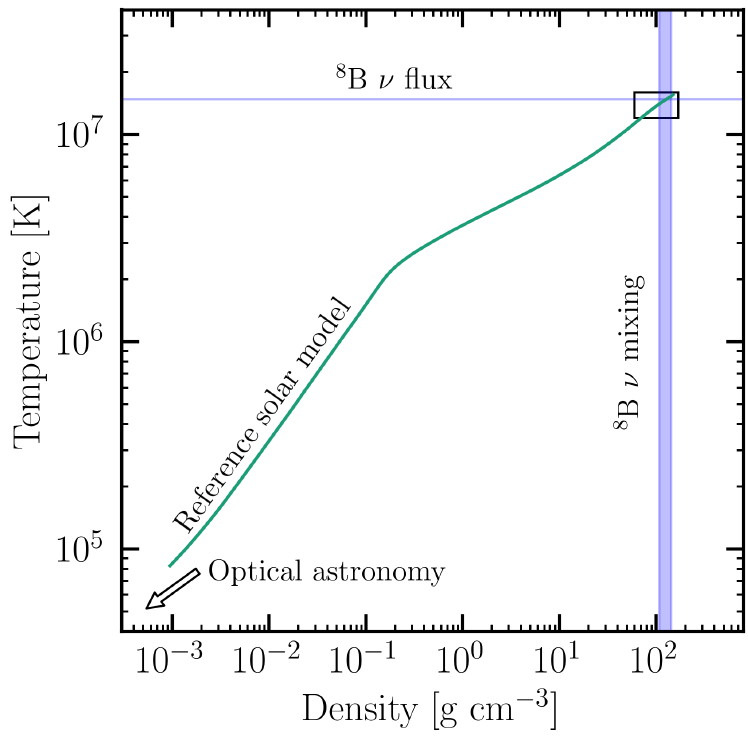
I'm betting you've heard of the Sun before, and *maybe* you've looked directly at it. While I definitely don't recommend doing so with your eyes, astronomers can use fancy telescopes to make observations of the Sun's surface. While this allows us to see the Sun's outer layers, we can't see any deeper because the Sun is opaque: it's bright, but you can't see through or into it. How, then, do we study the solar interior? In my first-ever paper, we showcase a new method for studying the inside of the Sun using neutrinos, which are fundamental, subatomic, rarely interacting particles produced in the Sun's core.
Read our paperSolar Structure

Humanity has relied on and had a fascination with stars since antiquity. Ancient people looked up at the night sky both with awe and determination as they built mythologies around the constellations and navigated the Earth’s seas using the stars. Unaware that the Sun is also a star, our shared ancestors all lived, struggled, loved, and died under the same sunshine and starlight. As part of my Doctoral Candidacy Exam and satisfying of the requirements for my M.S. degree in Physics, I explore the physics necessary for explaining the interior structure of the Sun and how it shines.
Check out my Candidacy Exam materials